Beyond Barriers: On Jane Austen’s Portrayal of Gender Roles in Pride and Prejudice

With Jane Austen being a prolific author and an influential female figure through her work to this day, the topic of gender progressivism in Jane Austen’s Pride and Prejudice has been a source of much curiosity for both casual readers and scholars, including myself. The conceptual problem of how Austen depicts the concept of female autonomy in the novel I find intriguing. I intend to produce my own analysis and synthesize parts of different scholars’ arguments to contribute to the discourse with my own unique argument that looks at female independence as depicted across different themes in the book. I believe approaching the topic using the concept of autonomy is significant because it can permit a comprehensive evaluation of a marriage-centric story. How, through the lens of “autonomy,” does Jane Austen portray gender roles in Pride and Prejudice? Although some critics may claim Austen’s depiction of women in the novel conformed to the patriarchal societal norm at the time and was therefore more conservative, I argue Jane Austen conveyed to a degree a progressive portrayal of gender roles in Pride and Prejudice through how she emphasizes female autonomy by giving women choices regarding marriage, promoting more substantial education for women, and allowing women’s transcendence of gender normative definitions of everyday social conduct.

First, one way in which Jane Austen portrays a progressive view of the role of women in Pride and Prejudice is through her depiction of female autonomy in marriage, as marriage is emphasized and portrayed in the story as an institution in which women have choice. For example, Elizabeth Bennet rejects Mr. Collins’ proposal (Austen 100-101) and rejects Mr. Darcy’s first proposal, an interaction during which she tells Mr. Darcy, “‘You could not have made me the offer of your hand in any possible way that would have tempted me to accept it’” (Austen 181). Darcy extends the proposal and Elizabeth asserts her own authority and freedom of choice by aggressively denying his proposal, which is significant because of what this freedom means in the literary and historical context. In a society wherein there existed “no other means open to the maturing female besides marriage” (Stone 71) and marriage was the “only real choice” for “economic security and a respectable, fulfilling life” (Swords), the fact that Elizabeth prioritizes herself—her happiness and values—in the aforementioned rejections, over what her family and community would expect as a traditional “female goal,” is significant. Elizabeth is not governed by external worries of financial stability or outsiders’ perceptions, but by herself. Importantly, her autonomy is depicted as something positive and powerful. While Elizabeth rejecting Mr. Darcy’s proposal in this scene “ideologically should lead if not to death, at best to genteel poverty and spinsterhood” (Newman 705), she is not punished by Austen’s narrative. Instead, she is rewarded. Her rejection of Darcy’s first proposal leads to Darcy’s self-development (Wiesenfarth 265)—with the woman’s independence being so great it prompted the man’s growth—and Elizabeth later enters into a happy and self-chosen engagement with the reformed Mr. Darcy (Austen 346). Thus Austen depicts a degree of gender progressivism by using her narrative to approve and reward female autonomy in the choice of marriage.

Second, another way in which Austen portrays a progressive view of the position of women in Pride and Prejudice is through her promotion of the value of women’s autonomy in the avenue of education, in the sense that women’s learning is not completely governed by social expectations and the purpose of education is to learn, rather than to prepare for marriage and the domestic sphere. At the time, women were thought to be intellectually inferior to men and were generally educated in a very limited manner with a few courses meant to be “sufficient to provide a girl with the accomplishments necessary to attract a suitable husband” (Swords). Women’s learning was less about actual learning and self-development than it was about getting married. However, in a discussion about female accomplishments that happened upon Elizabeth’s choice to read a book,Mr. Darcy ridicules traditional female accomplishments, saying that the word “accomplished” is used to describe “many a woman who deserves it no otherwise than by netting a purse, or covering a screen” (Austen 35), while also emphasizing the importance of a woman improving her mind through “extensive reading” beyond such accomplishments (Austen 35). Having a man, to whom such accomplishments were supposed to appeal, instead ridicule the focus on those accomplishments emphasizes the criticism against the idea that the goal of women’s education should be marriage. As reading was the primary way through which women in this time could more substantially educate themselves (Swords), Austen writing Darcy as staunchly advocating for women to educate themselves beyond what society desired and to learn for the purpose of intellectual development is progressive in how it supports women acting autonomously and independent of societal expectations.

Third, another avenue through which Austen portrays a progressive view of the role of women in the narrative is her positive depiction of women transcending traditional standards of female propriety in everyday social conduct. One example is when Elizabeth walks to visit Jane at Netherfield after Jane falls ill during a visit (Austen 29-30). Miss Bingley and Mrs. Hurst suggest the issue to surround gender by bringing attraction and appearance into the conversation, as they criticize Elizabeth’s choice to walk there by attacking her appearance afterwards and Miss Bingley describes it as showing an “abominable sort of conceited independence” (Austen 31-32). There is subtext about female propriety in this interaction (Johnson 164). Miss Bingley seems to consider such behavior unacceptable for respectable women, considering her insults about Elizabeth disregarding her appearance in a way Miss Bingley believed would make her unattractive to Mr. Darcy. However, in response to Elizabeth’s actions, which here represent autonomy considering she behaves independent of and ungoverned by standards of feminine decorum, Mr. Bingley and Mr. Darcy offer praise, with the former saying it shows a “pleasing” sisterly affection (Austen 32) and the latter describing Elizabeth’s eyes as “brightened by the exercise” (Austen 32). That the two men perceive Elizabeth’s autonomous behavior in transcending gender normative standards of female propriety as a positive thing is significant, as it implies the romantic narrative’s approval of such autonomy. Another example is when Elizabeth suggests she and Miss Bingley “teaze” and laugh at Mr. Darcy (Austen 51). When Miss Bingley says she and Elizabeth ought not “laugh without a subject,” Elizabeth responds, seeming astonished that “Mr. Darcy is not to be laughed at” (Austen 52). Elizabeth continues her verbal assertiveness, poking fun at Darcy with verbal barbs like “…your defect is a propensity to hate every body” (Austen 53) and “that is a failing indeed!” (Austen 53). Unlike Miss Bingley, whose words and actions in scenes like one wherein she seeks Darcy’s attention by talking about her enjoyment of his hobby of reading are intended to gain Mr. Darcy’s approval in a manner representative of a traditional woman in the patriarchal society (Chang 78), Elizabeth does not act to flatter Darcy. Instead, she calls attention to his weaknesses and acts to mock and ridicule him. Elizabeth’s behavior is autonomous in how she does not confine herself to a gendered expectation of seeking male approval but confidently and aggressively challenges a potential suitor while asserting her opinions. Importantly, Mr. Darcy smiles as he responds to her jab with one of his own (Austen 53) and his level of attraction immediately after this conversation is strongly suggested as he felt “the danger of paying Elizabeth too much attention” (Austen 53). Again, the romantic narrative paints Elizabeth’s autonomous behavior, which transcends traditional gender normative standards of female propriety, in a positive light by approving it. It is a progressive portrayal, as it is suggested her independence makes her attractive, rather than pure conformity to the traditional standards of how a woman should properly behave. She does not limit herself to behavioral bounds established as the norm in a patriarchal society. 

Some might say the way Austen portrayed gender roles was hardly progressive, since Austen concludes the narrative with Elizabeth getting married to Mr. Darcy (Austen 359) and thus might understand Elizabeth as “conforming” to social expectations. Critics might argue that any independence Elizabeth may have demonstrated as a single woman in the rest of the novel was lost upon her deciding to conform to society’s expectations of marriage by marrying Mr. Darcy. Indeed, Alistair Duckworth says in his review of five authors’ works that three of his reviewees—Mary Evans, Nancy Armstrong, and Claudia L. Johnson—all recognize how Austen establishes marriage as a societal norm through “plot and characterization” in her novels (85), with Armstrong suggesting Austen, in Pride and Prejudice, endorses the “sexual contract” (Duckworth 78). However, I argue the immediate criticism of marriage as conformist and therefore conservative is unreasonable in this context—a key factor in the issue is choice. Autonomy is about being able to make decisions for oneself. As Judith L. Newton writes, “Elizabeth’s autonomy… frees her to choose Darcy, and Elizabeth’s untraditional power is rewarded, not with some different life, but with woman’s traditional life” (39). Elizabeth was not coerced into marriage because society forced her to do so—she chose the relationship of her own accord, and that is what makes all the difference. She has not sacrificed her autonomy but has used that autonomy to choose a path based on her values, even if that path is more traditional. Austen demonstrates how women can still hold autonomy and power while “conforming.” Her progressive portrayals of such autonomy are not negated by the marriage plot—they challenge traditional standards, even if not necessarily radically so.

Casual readers and scholars may forever continue debating how Jane Austen portrays women and their relationship with society in this famous novel. By addressing the topic of gender roles in Pride and Prejudice in a distinct and unique way through focusing on how Austen depicted the overarching concept of female autonomy across the subjects of marriage, education, and everyday social conduct in a progressive manner, I am confident my argument is a significant contribution to the scholarship surrounding the presentation of gender roles in Austen’s work. Further study could be done by considering the depiction of autonomy in other aspects of this book beyond marriage, education, and conduct, and even by applying the same question of how autonomy is used to Austen’s other works.

Works Cited

Austen, Jane. Pride and Prejudice. 1813. Barnes & Noble, 2015.

Chang, Hui-Chun. “The Impact of the Feminist Heroine: Elizabeth in Pride and Prejudice.” International Journal of Applied Linguistics & English Literature, vol. 3, no. 3, May 2014, pp 76-82, https://dx.doi.org/10.7575/aiac.ijalel.v.3n.3p.76.

Duckworth, Alistair M. “Jane Austen and the Construction of a Progressive Author.” Review of Desire and Domestic Fiction: A Political History of the Novel by Nancy Armstrong, Jane Austen and the State by Mary Evans, Jane Austen: Women, Politics, and the Novel by Claudia L. Johnson, Jane Austen and the Province of Womanhood by Alison G. Sulloway, and Between Self and World: The Novels of Jane Austen by James ThompsonCollege English, vol. 53, no. 1, Jan. 1991, pp. 77–90. JSTOR, http://www.jstor.org/stable/377970.

Johnson, Claudia L. “A ‘Sweet Face as White as Death’: Jane Austen and the Politics of Female Sensibility.” NOVEL: A Forum on Fiction, vol. 22, no. 2, Winter 1989, pp. 159-174. JSTOR, https://www.jstor.org/stable/1345801.

Newman, Karen. “Can This Marriage Be Saved: Jane Austen Makes Sense of an Ending.” ELH, vol. 50, no. 4, Winter 1983, pp. 693-710. JSTOR, https://www.jstor.org/stable/2872923.

Newton, Judith L. “‘Pride and Prejudice’: Power, Fantasy, and Subversion in Jane Austen.” Feminist Studies, vol. 4, no. 1, Feb. 1978, pp 27-42. JSTOR, https://www.jstor.org/stable/3177624.

Stone, Donald D. “Victorian feminism and the nineteenth-century novel.” Women’s Studies: An Interdisciplinary Journal, vol. 1, no. 1, pp. 65-91. Taylor & Francis Online, https://doi.org/10.1080/00497878.1972.9978298.

Swords, Barbara W. “ ‘Woman’s Place’ in Jane Austen’s England.” Journal of the Jane Austen Society of North America, Persuasions #10, 1988, pp 76-82, http://jasna.org/persuasions/printed/number10/swords.htm.

Wiesenfarth, Joseph. “The Case of ‘Pride and Prejudice’.” Studies in the Novel, vol. 16, no. 3, Fall 1984, pp. 261-273. JSTOR, https://www.jstor.org/stable/29532288.

[Previously submitted by myself for a college writing assignment.]
Turned Tables: Female Gender Roles in The Merchant of Venice and The Taming of the Shrew

            Historical literature is often considered to be an author’s reflection of their own society and its values, but Shakespeare’s marriage-centric plays from early modern England deserve a second look for how they portray women and their roles in male-female relationships. Scholars have addressed the topic of gender role portrayal in these two plays, but in this paper I will synthesize my own argument and analysis in relation to those of six scholars to freshly approach the discourse of gender-normativity in the combination of these two Shakespearean plays through a focal point of love as a concept, not limited to only romantic relationships but also parental relationships. I believe this set of ideas is important and significant as it allows for a more encompassing investigation and perspective on Shakespeare’s portrayals of female characters in two plays well known individually for their emphasis on the traditional social institution of marriage, rather than isolating either romance or family relations. What role does the concept of love play in the discourse about Shakespearean gender-normativity, then, within these marriage-centric plays? Although some might claim that Shakespeare’s portrayals of institutional possessive love in his plays establish a patriarchal gender-normative view of submissive women, I argue that synthesizing interpretive analyses of The Merchant of Venice and The Taming of the Shrew allows us to see how the concept of possessive love within these marriage-romance plays was used to construct character relationships that inform the rejection of gender-normative female objectification and subjugation, considering how the plays depict the power dynamic between daughters and fathers in parental love, dialogic displays of female sexual autonomy in romantic relationships, and controlled female submission in marriage.

            First, how Shakespeare depicts the power dynamics in father-daughter relationships in The Merchant of Venice and The Taming of the Shrew demonstrates one way in which the concept of possessive love was used to construct relationships rejecting gender-normative female submission. We can start by considering a scene from The Merchant of Venice, wherein the character Shylock is depicted as losing “his stones, his daughter, and his ducats” when his daughter Jessica elopes with her lover (Shakespeare, Merchant 2.8 lines 1070-1083). The loss of stones, being era slang for testicles, is significant here if we interpret it as representing Shylock’s masculinity and status as the head of the household since this line therefore suggests that Jessica, by eloping, has stolen away his masculinity (Moulton 1411-12). This perspective is important in how it redefines the power dynamic in the relationship between Jessica and Shylock. Considering how women in Shakespeare’s time were viewed in a gender-normative fashion as owned and controlled by their fathers (Moulton 1410), if Jessica’s abandonment of her father allows her to steal away Shylock’s authority not only as a father—since he loses her as a daughter—but also as a man, it accordingly suggests a departure from the traditional power dynamic between men and women and from the traditional gender-normative role for women as objects of possession because Shylock’s daughter thus has ultimate control over Shylock’s role as a father and as an authoritative male, rather than being the weaker one in the father-daughter relationship. In fact, I could additionally argue that Jessica is portrayed as possessing Shylock and his masculinity for herself, considering how the dialogue implies that she essentially steals the physical representation of masculinity away with her when she elopes, thereby reversing the power and gender order.

            The father-daughter relationship between the character Kate and her father Baptista in The Taming of the Shrew also reflects a departure from traditional gender-normative roles. Considering that this particular play is quite literally about a male character—Petruchio—and his attempt to shape a feisty woman—Kate—into the ideally submissive woman for him to marry (Shakespeare, Taming), this work of Shakespeare has often been read as condoning or accepting the patriarchal dominance of women normal for Shakespeare’s time (Smith 289). However, we can take a closer look, for now focusing on a scene wherein a discussion of betrothal occurs, with Baptista responding to Petruchio’s talk of confirming of a betrothal by saying, “Ay, when that special thing is well obtain’d/That is, her love, for that is all in all” (Shakespeare, Taming 2.1 lines 964-979). Thus, the existence of the betrothal depends on Kate’s personal desires (Smith 303) and on Petruchio being the receiver of her love. Like how Shylock’s daughter held a degree of control over her relationship with her father, Kate possesses a certain autonomy in her relationship with her father who cannot give Kate to Petruchio in marriage without her individual consent, which would come in the form of love for Petruchio. The idea that Kate’s consent is necessary for an exchange wherein daughters are usually considered possessions of their fathers is significant, then, because the simple fact that the daughter is acknowledged as having a degree of autonomy and authority marks a shift in the gender-normative role of objectification often applied to women within a father-daughter relationship.

            Second, the way in which Shakespeare portrays conceptual female sexual autonomy through dialogue and conversation further demonstrates how the idea of possessive love was used to construct male-female relationships that reject gender-normative roles for women. Portia, a central character from The Merchant of Venice, is a strong example of this idea when she threatens her husband Bassanio with celibacy (Parten 152), saying, “By heaven, I will ne’er come in your bed until I see the ring!” (Shakespeare, Merchant 5.1 lines 2611-2612). Not only does Portia threaten her husband by withholding her body in regards to sex, she also threatens him with the chance of her own infidelity, saying, “I will become as liberal as you: I’ll not deny him anything I hate, No, not my body, nor my husband’s bed… I’ll have that doctor for [my] bedfellow” (Shakespeare, Merchant 5.1 lines 2649-2651, 2656). The fact that she can threaten Bassanio with the refusal to have sex with him or to do it with someone else implies the level of control she has in their relationship. If we consider how early modern England viewed wives as belonging to their husbands (Moulton 1414), these verbal threats are especially significant in context, since we see that through the guise of possession, Shakespeare portrays Portia as refusing a traditional, patriarchal view of obedience by women—she is not passive, but incredibly aggressive by holding her sexual autonomy over her husband’s head. She asserts her control over her own sexuality rather than being objectified as a woman in this time would have been otherwise, and therefore is an example of a woman completely rejecting the gender-normative role of a submissive wife. Portia turns the tables on the dynamic of dependence and assumes a position of power in her relationship with Bassanio such that he is now the one dependent on her and her control over himthrough her sexuality.

            There is a similar portrayal of dialogic female sexual autonomy in The Taming of the Shrew, wherein occurs a scene featuring Kate and Petruchio interacting (Shakespeare, Taming 2.1 lines 1033-1093) through what Amy L. Smith deems highly sexually-charged dialogue involving “rapid-fire puns and sexual invitations and rejections” (Smith 301). In a basic sense, Kate is asserting her sexuality by taking on an interactive role in the conversation and dialogue with Petruchio, offering her own sexual retorts (Smith 300) and the line “If I be waspish, best beware my sting” (Shakespeare, Taming 2.1 line 1066 ), which Smith considers “the most sexually explicit dialogue in the scene” (Smith 301). We can look to Ela İpek Gündüz for contextualization, as they assert that in Shakespeare’s society, women ought to act “totally obedient and submissive” (Gündüz 838).  Additionally, Karen Newman writes that the ideal woman of Renaissance society was to be “chaste, silent, and obedient” (Newman 29). If women in Shakespeare’s time were expected to be voiceless as well as submissive and demure in sexuality, then Kate is going far beyond the gender-normative role for a woman here through her actions here within her love relationship with Petruchio. Like Portia, Kate is asserting her sexuality by taking on an interactive role in the conversation rather than a passive or submissive role wherein she might have allowed Petruchio to goad her with his own sexual speech. She does not allow him to completely woo or tame her despite Petruchio’s attempt to possess her for himself (Smith 300). I would like to emphasize a point in addition that Kate here is acting as a willing female participant creating the sexual dialogue rather than allowing it to remain a monologue acting as an attempt of taming her, a woman, which is significant as the move represents her putting herself on equal footing with the man in the heterosexual relationship. As a result, we see that Shakespeare portrays Kate here as an individual with verbal sexual autonomy and ownership of her sexuality, thus informing the construction of a male-female love relationship that rejects gender-normative roles for women, alongside Shakespeare’s portrayal of Portia of The Merchant of Venice.

            Last, Shakespeare’s depictions of self-controlled female submission within marriage in The Merchant of Venice and The Taming of the Shrew represent another way the concept of possessive love is used in the construction of character relationships that reject a gender-normative role for women. The scene in The Merchant of Venice wherein Portia recites her wedding vow and love pledge to Bassanio and wherein she gives him a ring is an example of such a self-controlled submission (Shakespeare, Merchant 3.2 lines 1505-1530). We can read this act of gifting a wedding ring as symbolizing Portia handing over her wealth and her body to Bassanio (Park 4), and thus this ring represents Portia’s chosen submission to her husband. I would argue that the simple fact that Shakespeare portrays Portia as having the independent capability to choose to give Bassanio control over her life is giving Portia a position of authority in the relationship, because on a larger scheme, this portrayal suggests the innate power of submission—if one refuses to be a wife to her husband, then her husband cannot be a husband. We can read further into the analysis however, since through this exchange, Portia is also reversing the traditional role of the man being the one to give a woman the ring, thus putting the expectation of a faithful and submissive spouse on Bassanio instead (Park 5). Therefore, through Portia’s control in her decided submission, she actually gains a position of power in her relationship. Through the lens of possessive love as a concept, paradoxically, Bassanio becomes the one who must be obedient because Portia submits to him—he becomes the possession. This idea is significant because Shakespeare essentially allows Portia to reverse the gender roles in her love-relationship with Bassanio through an exchange that would traditionally make her the “object” being possessed, therefore rejecting the gender-normative view of a wife’s role by allowing her to transcend the normal boundaries of her position as a wife and giving her character far more power than would be expected in Shakespeare’s society.

            Female submission is a narrative device shared by The Taming of the Shrew and carries a similar significance within the play. At the end of the storyline, Kate enters the socially submissive role of a wife by marrying Petruchio and gives a speech to other wives about the importance of obeying their husbands (Shakespeare, Taming 5.2 lines 2677-2720). The speech itself is a performance for the other husbands and wives in the play and can be read as a performance on a larger scale, for society as a whole (Gündüz 842, Smith 313), demonstrating Petruchio’s apparent subjugation of Kate. A performance is controlled by the actor—here, the actress—and Kate’s speech performance she dictates. Therefore, I would argue that Kate’s performance of submission here actually acts to allow her to maintain her autonomy in the societally-constrained position of a wife rather than demonstrating Petruchio as having complete ownership over her. Amy L. Smith comments on this scene, claiming that Kate “emphasizes not the husband’s dominance but the wife’s submission, and thereby she gives the power of future performances to the wives… Kate is not determined by her script of obedience but rather reiterates it in a way that reminds the audience that all of the power in this relationship does not lie entirely with the husband” (Smith 314). I would add to Smith’s point and say that by implying the power of women to act and perform as wives, Kate’s performance emphasizes not only the interactive role Kate takes on in her relationship with Petruchio, wherein his authority as a husband cannot be fulfilled without her decision to comply as a wife, but also the interactivity of the very system of marriage. She allows him to portray himself as a powerful man and husband by performing a role as Kate the submissive wife, and in that sense, Kate holds a significant degree of power in the very existence of their relationship, since Petruchio does not possess her unless she allows him to do so by performatively submitting as the character Kate plays. She reshapes and reinterprets submission (Smith 314), making it into something that affords her a degree of control. As such, Shakespeare’s portrayal of Kate as an autonomous woman even in a state of what his society would deem wifely submission demonstrates how he, through depictions of possessive love, constructs a male-female relationship departing from patriarchal gender-normative objectification of women in their social roles.

Some might, by focusing solely on the overall results of the narratives, argue that the concept of possessive love in these Shakespearean plays serves only to further establish patriarchal gender-normative roles for the women in the plays, considering how the plays are centered around the traditionally gendered concept of marriage. They might say The Taming of the Shrew is inherently patriarchal and only puts women into the gender-normative role of submission and subjugation, considering the narrative of “taming a woman as if she is an animal” (Gündüz 840) and how in the end Kate is technically tamed into marriage and into giving a speech that “implies a straightforward acceptance of submission” (Smith 289). In regard to The Merchant of Venice, they might say as Anne Parten does about the topic of Portia’s ring, that “a context is created in which this can be laughter at the mere thought that such an action as cuckoldry should be performed… laughter at the thought that order could be broken is a sure sign that order has been restored” (Parten 154). They might argue, then, that the character of Portia is still in a position of wifely submission, because her threat of cuckoldry is simply an unrealistic threat which thus “tell[s] the audience explicitly that…she will not dominate [her husband]” (Parten 150). However, I remain firm in my argument, because it is important to remember that these plays were meant to be public performances that could entertain wide audiences. As Amy L. Smith says, “to claim that a reiteration of marital hierarchies is merely reinstating the status quo is to ignore the power of performativity” (Smith 315). There would be few people in the audience if Shakespeare had written the female characters as complete heroines in such a patriarchal society. I argue, then, that what we see in his plays is a form of compromise, because language and rhetoric are just as important as narrative when it comes to theatre and literature, and never should a performance be taken at face value. By utilizing the concept of possessive love to construct different types of male-female relationships, Shakespeare portrays strong female characters who manage to assert a degree of authority over men either explicitly or subtly but who still demonstrate how women can attain some level of control over their own lives in the society in which Shakespeare lived. Simply offering a new perspective on women’s social roles within relationships is a way of challenging tradition.

It is likely that there will always be debate about how Shakespeare depicts gender roles within his plays. My synthesized analysis on how Shakespeare uses the concept of love to depict male-female relationships with non-gender-normative roles for women is a way for me to expand on existing scholarly arguments. Still, I am confident that my contribution is significant, as I consider this paper to be written through a uniquely comprehensive lens that addresses the subject of gender normativity by combining the idea of possessive love with the investigation through different forms of love-based relationships—parental and romantic—rather than through just one or the other. It is a discussion useful in the discourse about gender normativity in Shakespeare’s many plays, and future investigation of the subject through lenses beyond my choice of love as a concept could continue to reveal novel perspectives and understandings of what Shakespeare tells us through his stories.

Works Cited

İpek Gündüz, Ela. “Gendered Identities: Shakespeare’s Taming of the Shrew”. Gaziantep University Journal of Social Sciences, vol. 17, no. 3, pp 834-844.

Moulton, Ian Frederick. “His stones, his daughter, and his ducats’: the rhetoric of love and possession in early modern Europe”. Textual Practice, vol. 33, no. 8, pp 1409-1425.

Newman, Karen, “Portia’s Ring: Unruly Women and Structures of Exchange in The Merchant of Venice”. Shakespeare Quarterly, vol. 38, no. 1, pp 19-33.

Park, Jae Young. “Symbolic Meanings in the Wedding Ring in the Merchant of Venice: Religious Conflicts and Matriarchal Challenge”. ANQ: A Quarterly Journal of Short Articles, Notes and Reviews, pp. 1-8.

Parten, Anne. “Re-establishing sexual order: The ring episode in The Merchant of Venice”. Women’s Studies: An Interdisciplinary Journal, 9:2, pp 145-155.

Shakespeare, William. The Merchant of Venice from The Folger Shakespeare. Ed. Barbara Mowat, Paul Werstine, Michael Poston, and Rebecca Niles. Folger Shakespeare Library, May 8, 2020. https://shakespeare.folger.edu/shakespeares-works/the-merchant-of-venice/

Shakespeare, William. The Taming of the Shrew from The Folger Shakespeare. Ed. Barbara Mowat, Paul Werstine, Michael Poston, and Rebecca Niles. Folger Shakespeare Library, May 8, 2020.  https://shakespeare.folger.edu/shakespeares-works/the-taming-of-the-shrew/

Smith, Amy L. “Performing Marriage with a Difference: Wooing, Wedding, and Bedding in The Taming of the Shrew”. Comparative Drama, vol. 36, no. 3/4, pp 289-320.

[Previously submitted by myself for a college writing assignment.]

Our Butterfly

Disclaimer: This poem is my original content that I have additionally published through UCSD’s Other People Literary Magazine.

Were it by chance when stars had cross’d unseen
Our paths now joined perchance made course a-part
We playwrights, though, set up our present scene
from impulse down and up to pair-link’d heart.
Spoke first time we when shared event had hapt 
Had I stayed hour less, or you come in hour late
Had we spoke not of that which keeps us rapt
My appetite may’ve ne’er known your gift to sate.
No tears have I cried since meeting you
and all I’ve the need to give is my laughter
Our moments joint painted peerless hue 
Born of friendship’s bosom all thereafter.
T’was our gossamer wings bringing us high
Praise our choices made as our butterfly.

With you your compass, me my trusty sailboat
A pair from birth, the day we set adrift
But we had a row and now here we take note
the scarlet wings of fear we feel inside ocean’s rift.
You are the one who reads for us meant direction
I am the one who listens silent at shared helm 
You accuse me, for fault of my failed navigation 
As I respond, that instruction is your realm.
But you’d seen east and angry, said west
I had heard west but spiteful, turned east
We know but our choices keep us at rest
and we face not treasure but tragic beast. 
If only we could blame this on a fate worst
But ‘twas our butterfly that left us curs’d.

Voice

Your voice, signature of person as it exists,
lives to be found in the stories you tell.
It lurks behind the words you speak,
between the gaps in your breath
and within the way in which you punctuate your text.
But–it also is in every part of your gestures, your laughs
expressions the voice to which others bear visual witness.
Oh, how does your face alight when your loved ones call you?
and how does your laughter ring out when you hear a joker’s tale?
Your joy distinct, and your sorrow unique
A footprint of its very own,
caught in the strides of your name and self
and that voice, that individual, irreplaceable voice
lives to be found in the stories told about you.

Self-Chosen

Disclaimer: This poem is my original content that I have additionally published through UCSD's Other People Literary Magazine. 
----

A fortnight ago,
when the wind blew gray and nigh
he left his doors to enter
through the sullen quiet of the forbidden moor
in search of something he could call more his own
a quest, a journey, love or adventure’s sake
his destination along the horizon.
Beside him existed neither roaring seas
nor sublime cliffs
No trials almighty to be vanquished by heroes
But there is nothing quite like the open sight
of lilac heather amidst sage brush; still,
he looked, and turned, and averted his eyes
His gaze affixed to the line of light
breaking ahead of him.

At a fortunate intersection of brook and path
was he met by a lady of comely dress
Said she,
with a gesture to a pair of weeping willows, and a nod
to her lawn manicured with the riches of a thousand men,
—Welcome to my grounds, do join me inside,

I’ll put on a kettle of tea and bring out my good honey
I’ve not much company, you see.
I’ve waited so long for someone to talk to
Won’t you sit down with me?—
but our fellow laughed and
denied her with neither a glance o’er her valued domain
nor o’er her tender smile and eyes.
You’ve not what I desire, said he
I’ve no time for distraction.
Then farewell and continue on, she said,
and looked the other way
as he returned to his path in the weeds.

After some days, and nights, and afternoons too,
he wandered into an assemblage of persons, all ages
Said they,
with gestures to a flourishing table of hearty laughter, and nods
to the greenest pasture in the land,
—Please join our feast, celebrate with us a strong harvest
we’ve meat from our animals and wine from our grapes.
and you need not starve a day with our bounty of crops.
Come, take a look around,
we’d be delighted to show you the grounds—
but our man smiled small and
rejected them with neither a look o’er their precious gardens
nor o’er their glorious fruits and blossoms.
Your food and drink are not what I pursue, said he
I’ve no time for distraction.
Then farewell and continue on, they said,
and turned their backs on him as he fell back into step
in pursuit of his ever-chased light.

Rolling hills, scarlet birdsong, jeweled dew
Dandelions nodding their heads
All to the side of his path
And a small mouse, scurrying by, invisible
Accidental companion to the one forging
his way through the landscape
Asked another—
for what does he abandon such opportunity?
for what does he ignore such chance?—
The winds echoed his inquiry
as did the persons left behind
silently, in the depths of their minds
But our fellow’s sight remained steady.
And he walked,
and walked, and walked
and found nothing as the grasses passed him by
Satisfaction he sought

and for the welcoming calls he cared naught
A lonely journey, self-chosen
And the moor, well.
She said good riddance.

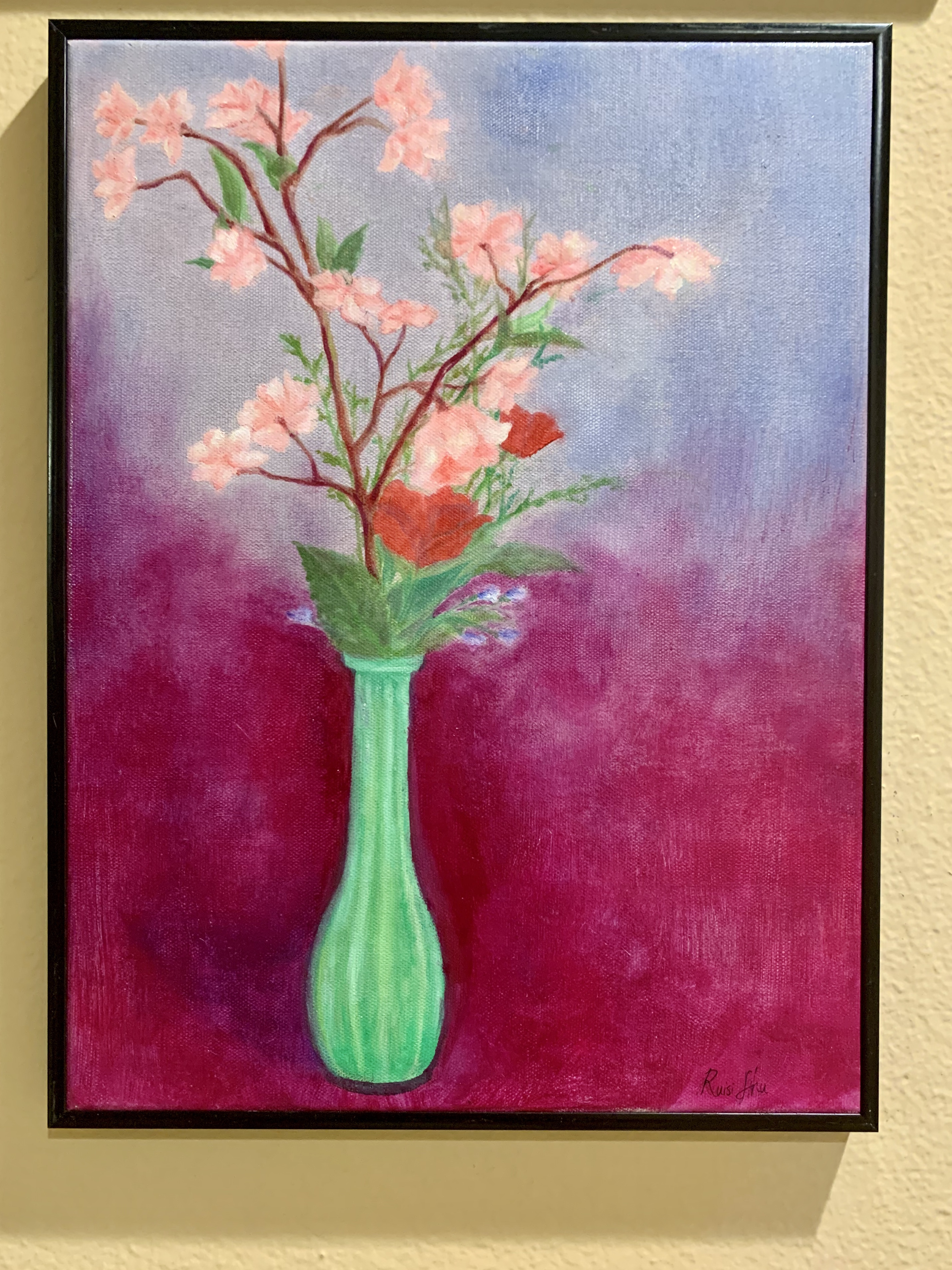
Working on a new WIP, but here’s a practice oil painting that I did fairly recently! Funnily enough, I only realized how much I like painting flowers by looking through my old pieces.

This work is one I’d pair with my poem “Empty Desk”:

A desk decorated bare but for a sea-green glass vase
filled with the two shiny stems of immortal flowers
and, sitting near, a small bottle of flower scented perfume.

Thus the flowers may live a day more
whilst the room remains.

En El Abismo

En el abismo del cielo morado
donde estás viviendo sin aire
levantas las manos sobre las estrellas
y permite que el fuego ilumine su alma.
Un pincel divino, con las acuarelas del viento--
pinta un horizonte infinito para los ojos ciegos
un horizonte de hierba dorada y rosas plateadas
En el silencio tú oyes la campanada
en la inquietud tuya sigues el río angosto
por el bosque en que los pájaros
musitan de una existencia gris
en una lengua que tú ya no puedes comprender
tan retorcido como los vides de pena
El río es de las lágrimas de angustia
y su agua está amarga
y un poco -solamente un poco- salada.
Un día de estos realizarás tú
que la senda que estás caminando
no tiene un destino real
Pero todavía necesitas la mirada fijada
en el sol que sólo se alza durante la noche.

Time -novel excerpt-

Time is the tatter-wingēd butterfly that flits, delicate, among the petals, occasionally pausing for a bead of saccharine nectar. It is a tree’s scrapbook of leaves, considered but never truly admired– when even a breath of air itself takes time.

To bask amongst the fresh fragrance of the tulips standing withered a decade later, the forlorn memories of a forgotten beauty taken with—

to dip one’s feet in the bubbling brook flowing still, but without the liveliness that made it so bright, brilliant—

—that is the feeling of a lost life, of lost time.

Articulation of dreams is no simple task, and at the intangible door of thoughts do wisps of hope await, intertwined, with the silken filaments of regrets and roads-not-taken; alas, one worries he may never live out his dreams, for the days, seasons, years—they pass much too quickly.

Wisdom grows with age, they say, and perhaps that it is true, but only if the entire definition of the word is flipped. Adults say, and they always will say, how children know nothing—that children are naive, ignorant, yet in reality they are the ones who see the world for what it is. The covert masks of strangers melt away in their eyes, their previously veiled shadows struck by the light, for the gentle hearts of youths find it effortless to trust and to love without preoccupation over ulterior motives or repercussions. As it is, it is only later that the absolute fickleness of human emotion and thought is discovered.

Some age faster than others. They are the youths whose sight can end up changing not only their lives, but even the sorrowful temporariness of other beings.

To them, life is no such dalliance.


Chasing the Sun

            We 
started
late in trying
to catch the pastel break of sunset
But the road winds around,
curving past the slopes and peaks of the hills
so that the light comes from behind,
from the right, from the left
And when night falls
we are abandoned in the dusk
smiles and eyes alight
Alone on this endless journey
chasing the sun.

Dedicated to my dear friend Cassidy.

Indents

Cross over the shallow running water
to where skyline meets buried rootstock
Jagged rocks peek past overgrown reeds
and the brushstrokes of rosy flutter plastered
with invisible droplets meld into ticking clockwork.
Indents in the wood worn over time remain
a Game played by Children and Adults alike.